MineTwin.ai

The mine that
knows your people.

AI-powered onboarding and operational intelligence for mining.

Your mine is complex. Bringing people up to speed doesn't have to be. MineTwin connects to your operational systems and builds a living intelligence layer - one AI guide that knows every role, every asset, and every answer.

Tell us who you are
This site adapts to you.

Select your role and we'll show you the content, data, and value proposition that matters most to you.

Why does it take a year for a qualified
professional to reach full productivity
at a new mine?

Induction is mandatory. Consistency hasn't been.

Consistent induction used to mean dedicated headcount. MineTwin is the headcount.

At scale, induction quality varies by site, by rotation, by whoever from HR, health & safety, or operations was available that day. MineTwin connects to your operational systems and understands your mine in context - more completely than any individual ever could, because no single person has full visibility across all of it at once. The same standard. Every person. Every site.

$1.8M
Direct labor cost of induction
per site, per year
1 yr
Before a new professional
reaches full productivity
~40%
Reduction in onboarding cost
Conservative model, labor only
<3 mo
Payback period at
$100K+ annual license

How do you get every new person
productive as
fast as possible?

Induction is mandatory. Consistency hasn't been.

Consistent induction used to mean dedicated headcount. MineTwin is the headcount.

For the first time, the knowledge your experienced people carry - the site, the equipment, the history, the context - lives in a platform instead of people. Induction has always depended on who was available. It doesn't anymore.

4+ hrs
Of operations expertise pulled
per induction event
0%
Of inductions tailored
to the specific role
~$749K
Annual savings potential
per site, direct labor only
Weeks
From data access
to live environment

Ground floor
of a category
with no
incumbent.

$1.8M per site per year in direct labor waste. 800+ qualifying mines globally. A founding team that already built this at enterprise scale inside one of the world's largest mining companies. We're productizing a decade of enterprise mining technology at $100K per year.

$1.8M
Direct labor waste
per site, per year
800+
Qualifying mine sites
globally
$0
Incumbent software
solutions in this category
75%+
Gross margin
software license model
COST
The same standard. Every site.
The Problem
You see the cost line.
You don't see what's behind it.
"The cost that shows up on the budget line is the one you already know about. The cost you can't invoice - institutional knowledge retiring out the door, productivity that ramps slower than it should, safety incidents clustering in the first 90 days - is the one doing the real damage."

The visible cost is the smallest one.
$1.8M

Direct labor cost per site per year - the part you can measure

2,350 induction events × 6 hours × loaded staff costs. That's one site. Most operators run dozens. It's a known number. It gets budgeted. It doesn't get fixed - because until now, there was no mechanism to fix it.

90 days

Where most safety incidents cluster - the window induction is supposed to close

New workers on unfamiliar sites. Generic briefings that didn't stick. Role-specific hazards that weren't covered. The incident rate in the first three months is a direct consequence of the quality of the induction that preceded it.

1 yr

Before a new professional is genuinely productive at your operation

They arrive qualified. They leave trained - eventually. The gap between arrival and full productivity is a year of reduced output, elevated supervision cost, and institutional friction. Multiply that across every new hire, every rotation, every site.

0

Systems that capture what your experienced people know before they leave

When your senior metallurgist retires, her 30 years of process knowledge retires with her. When your best pit supervisor moves on, every workaround he knew leaves too. The organisation keeps running. It just runs a little worse. Every time.

The induction event is not the problem. It's the symptom. The problem is that operational knowledge lives in people, not systems - and the only transfer mechanism available is a classroom session that depends on whoever has time to run it. MineTwin changes the architecture. The knowledge moves into the platform. It doesn't retire. It doesn't rotate out. It doesn't vary by who's available that day.
FRICTION
Consistent. Every rotation.
The Problem
You know exactly
how inconsistent it is.
"Some rotations it's your best H&S lead running induction and it's excellent. Some rotations it's whoever could be spared from HR or operations - and it shows. The content is the same PowerPoint. The delivery is not."

The system was never designed to produce consistency.
4+ hrs

Of operations expertise pulled per induction event

Inductions pull people from across the operation - HR, health & safety, and operations all contribute. The content is standardized in slide decks. But who delivers it, and how well, depends entirely on who's available that rotation. Every group loses hours they should be spending on their actual job.

0%

Of inductions are tailored to the specific role

The haul truck driver and the instrument tech sit through the same session. Different equipment, different hazards, different SOPs - same content. Not because anyone chose to do it that way. Because there was never a cost-effective way to do it differently.

Variable

Quality - depending entirely on who ran it that day

You've seen both ends. The H&S lead who covers everything thoroughly because she genuinely cares. The operations person who rushes through it because there's a breakdown on the ramp and his radio hasn't stopped. Same slide deck. Completely different outcomes.

Months

Before a new worker stops asking basic questions

They know the formal content. They don't know your site's specific quirks - which equipment has the recurring fault, which road gets icy first, who to actually call when something goes wrong at 3am. That knowledge takes months to absorb. And it comes at the expense of the experienced people who have to answer the same questions every rotation.

You can't fix this by trying harder. You can't hire a dedicated induction team - the budget doesn't exist. You can't guarantee your best HR, H&S, and operations people are all available every rotation - they have a mine to run. The only solution is to take the dependency on human availability out of the equation entirely. That's what MineTwin does.
OPPORTUNITY
No incumbent. Open category.
The Problem
$1.8M per site.
800+ sites.
Zero software solutions.
"Every remote mine in the world runs some version of the same broken induction process. Generic content. Inconsistent delivery. Operational expertise drafted to cover the gap. It has been this way for decades - not because no one cared, but because the technology to fix it didn't exist."

It does now.
21,000+

Staff-hours spent on induction per site per year - before a tonne of ore moves

2,350 events × 6 hours × 1.5 staff per event. That's the direct labor behind the headline number. Each induction pulls from HR, health & safety, and operations - three groups losing hours from their actual roles to deliver the same standardized slide deck, every rotation.

800+

Qualifying mine sites globally - and the problem exists at every one

Remote or FIFO operations, 300–1,000 employees, 30%+ annual turnover. That's the addressable market for Tier 1 alone. Every one of them is running this problem right now. None of them have a software solution for it.

$0

Incumbent software solutions in this category

Trimble, Hexagon, and Bentley sell asset registers and maps. None of them know who the workers are. Generic LMS platforms don't know the mine. No one has connected operational data, 3D spatial context, and role-aware AI into a single induction and knowledge platform. The category is open.

Decades

Of structural inefficiency with no technology solution - until 2025

The reason no one has built this is not that the problem isn't real. It's that the technology - reliable real-time AI, industrial 3D digital twins, affordable cloud infrastructure - only matured enough to make it possible in the last 18 months. The timing is not accidental. It's a window.

This is a structural problem in a capital-intensive, highly regulated, safety-critical industry. It recurs on every site, every rotation, every time a position turns over - which at 30%+ annual turnover means constantly. The company that builds the category-defining solution owns a recurring, defensible, expanding revenue stream at every mine it touches. No incumbent is building this. The window is open now.
PLATFORM
Knowledge that doesn't retire.
The Platform
A digital twin that knows your people
as well as it knows your equipment.

MineTwin connects to the systems you already run - your CMMS, ERP, HR platform, operational data - and builds a living intelligence layer on top. One AI guide. Every person. Every role. Every question.

The moment someone logs in, the system already knows their name, their role, their crew, their supervisor, their equipment assignment, and their certifications. The mine knows who they are before they ask a single question.

A haul truck operator gets the pit, the haul road network, and the ROM hopper. A metallurgist gets the flotation circuit, the reagent regime, and the lab. Same platform. Completely different experience. Delivered consistently, every rotation, without pulling anyone off the floor.

And it doesn't stop after orientation. The AI guide stays available - answering questions, surfacing data, explaining systems - for as long as the person is on site. The new shift supervisor at 2am who needs the fault history on a specific truck gets an answer in seconds instead of waking someone up.

The new mining engineer who used to need a year to understand what's actually going on has a tool that has been running on this operation for months already. It knows the mine. Now they can too.

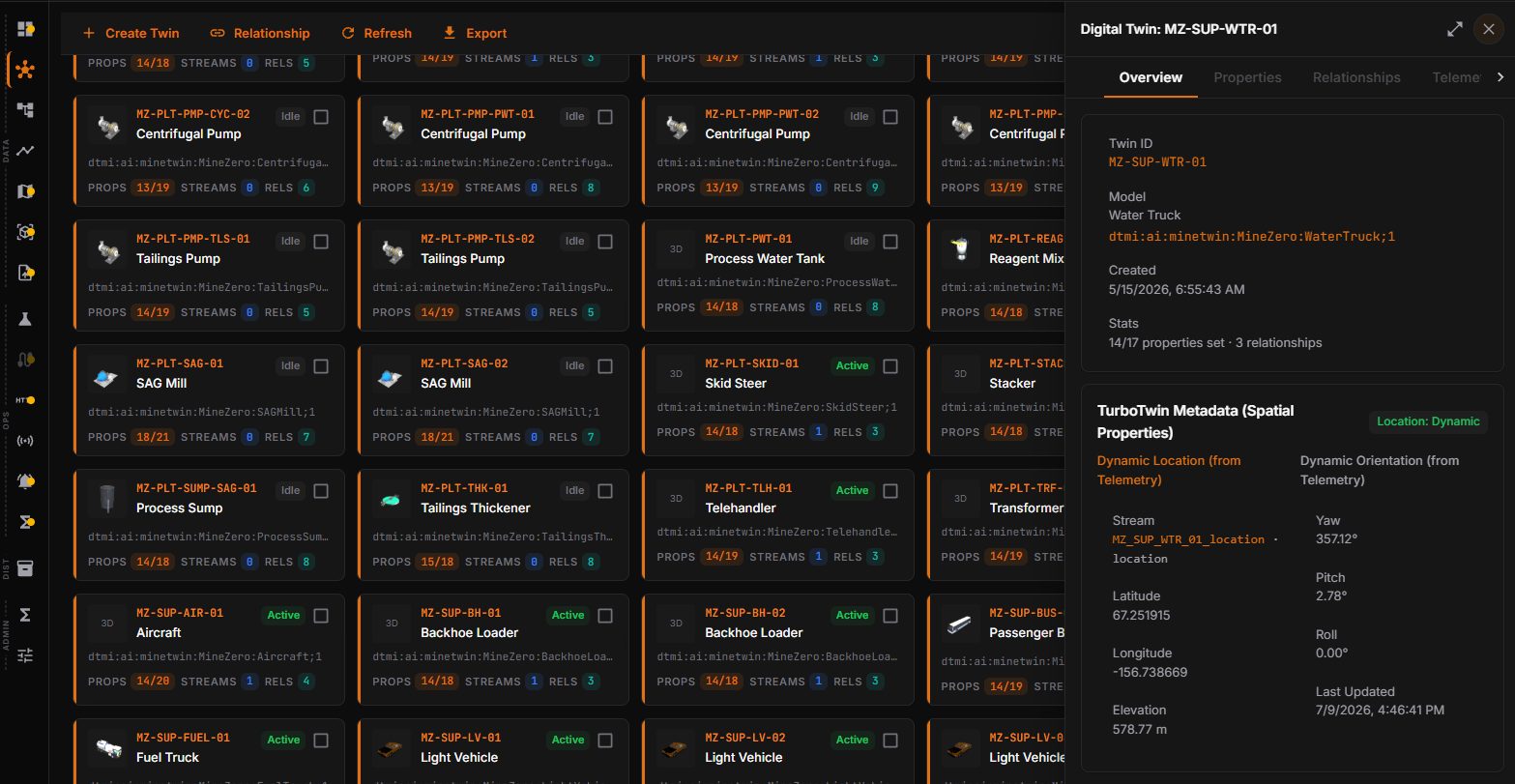
Under the hood: MineTwin's data engine ingests raw site data, cleans and categorizes it, stages and indexes it for real-time retrieval, and structures it into the Digital Twin knowledge graph that powers everything. The intelligence layer doesn't sit on top of a database - it understands the relationships between equipment, people, processes, and history.

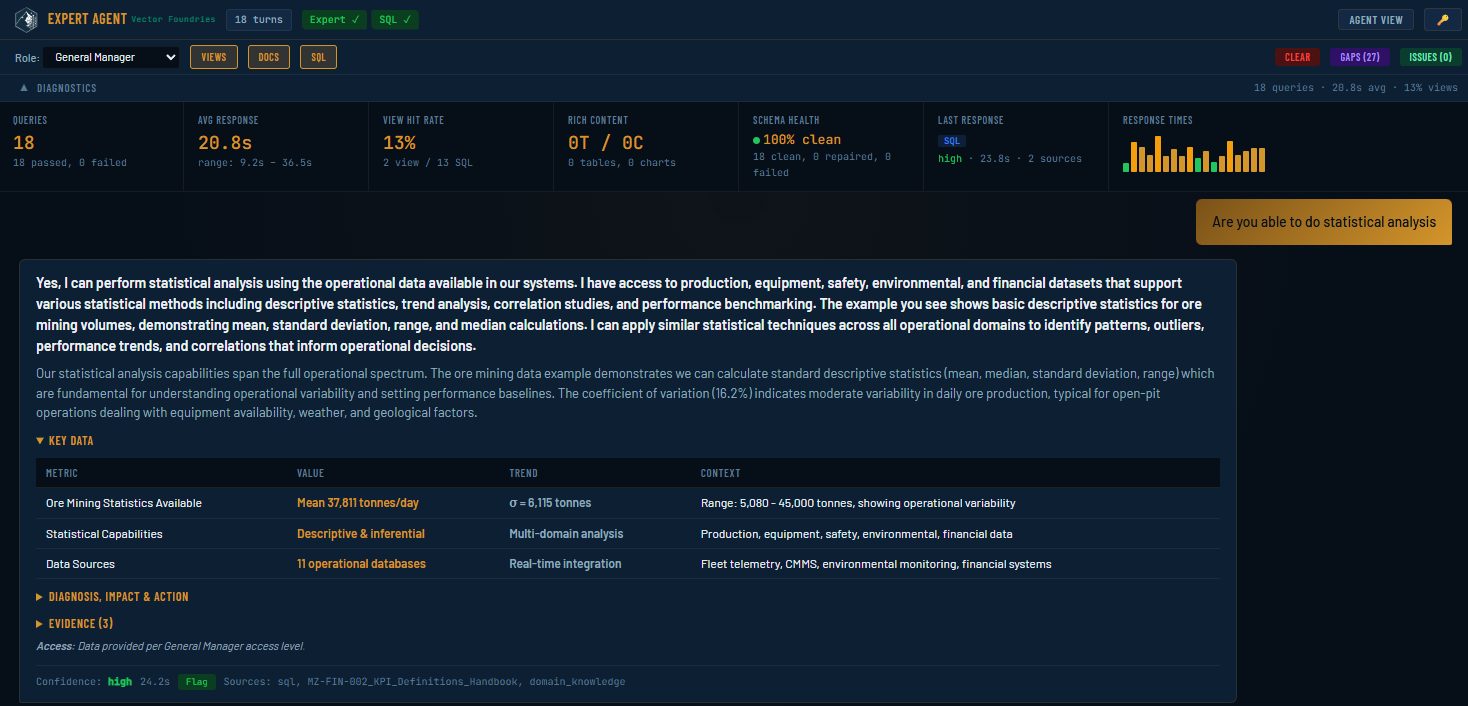
How the Expert Agent works: When your shift supervisor asks a question at 2am, the system checks pre-computed views first - 23 verified answers covering 80% of common questions, returned in under 10 seconds. If the views don't cover it, a SQL Agent converts the question to a live query against Databricks. It then generates testable hypotheses and checks them against the evidence. Finally, it synthesizes everything into a structured response: the answer, the data, an interpretation, and a recommended action. Every number is traceable - the agent never fabricates data.

Role-based access control: The system knows who's asking. A General Manager sees everything - financials, personnel, failure history. A Maintenance Superintendent sees their department's costs and equipment data. A Haul Truck Operator sees production and safety data relevant to their area - no financials, no personnel records. We have 9 role profiles covering 150+ job titles across the mining industry. This filtering happens at the AI level, not just the UI - if a role doesn't permit it, the data never reaches the user.

minetwin - expert agent
› Which truck is costing me the most - and why?

TRK-777-06: $847K over 12 months - 2.3× the fleet average.

Asset12-mo CostUtil %Status
TRK-777-06$847K71%Critical
TRK-777-03$412K86%Normal
TRK-777-11$389K83%Normal
TRK-777-08$371K84%Normal
Fleet avg$368K84%
Q1
$142K
Q2
$178K
Q3
$234K
Q4
$293K

14 recurring hydraulic faults - same code 11 times in 6 months.
Root cause: unresolved. You're treating the symptom, not the cause.
At current burn rate: +$200K in the next 90 days.

Confidence: High - source: maintenance_work_orders, fleet_costs
→ Recommend: root cause investigation before next PM cycle. Refer to Maintenance Superintendent.
01

Role-aware from the first second

Role, crew, shift, supervisor, certifications, access zones - loaded at login. The truck driver and the electrician are in completely different mines from the moment they arrive.

02

Your actual site in 3D

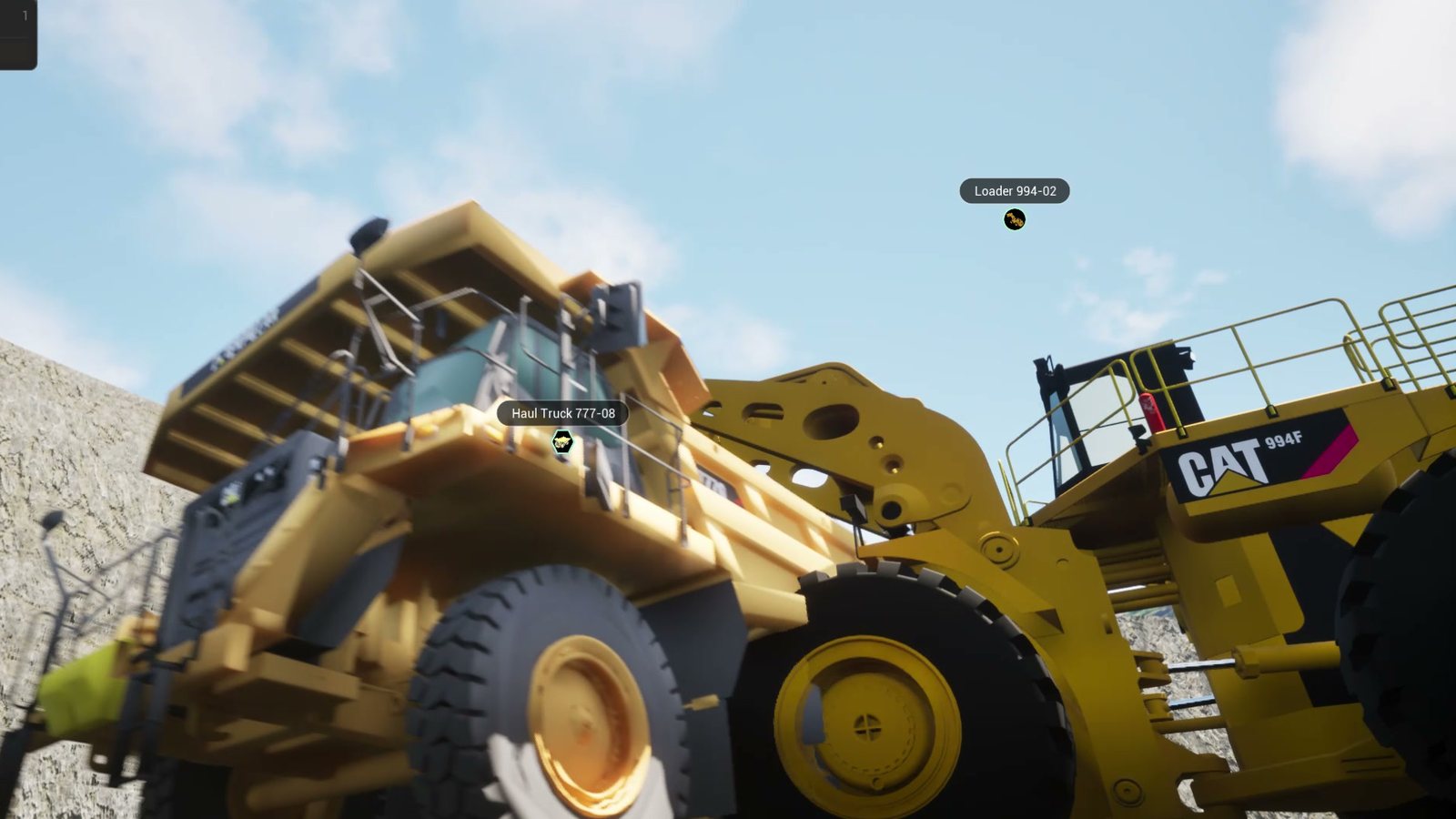
Not a diagram. A real-time digital twin of your mine - every asset placed, every relationship mapped. Ask a question and the 3D model highlights exactly what you're asking about.

03

A guide that never clocks out

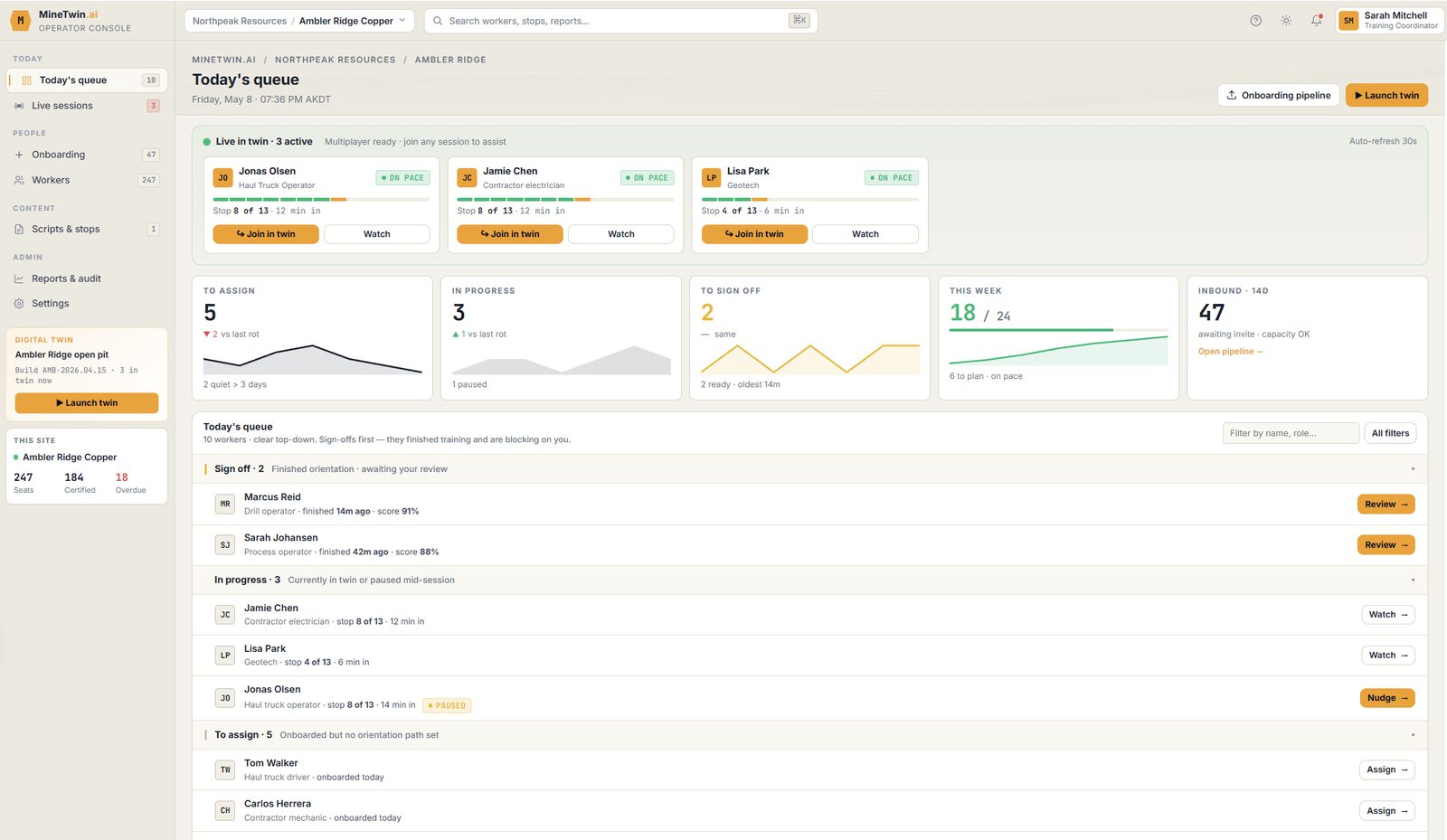
Four orientation durations - 5, 10, 20, and 60 minutes. Narration scripted with mining professionals, Q&A is live. After orientation, the AI stays - equipment history, SOPs, production data, cost centers - accessible any time.

04

Accessible from anywhere

Invitations sent to personal email. Inductees complete orientation before they set foot on site - reducing time on the ground and getting people productive from day one.

PLATFORM
First mover advantage.
The Platform
A digital twin that knows the mine's people
as well as it knows the equipment.

MineTwin connects to the systems a mine already runs - CMMS, ERP, HR platform, operational data - and builds a living intelligence layer on top. One AI guide per site. Every worker. Every role. Every question.

The moment a worker logs in, the system already knows their name, role, crew, supervisor, equipment assignment, and certifications. The mine knows who they are before they ask a single question.

A haul truck operator sees the pit, the haul road network, and the ROM hopper. A metallurgist sees the flotation circuit, the reagent regime, and the lab. Same platform. Completely different experience. Delivered consistently, every rotation, without pulling anyone off the floor.

The AI guide doesn't stop after orientation. It stays available - answering questions, surfacing data, explaining systems - for as long as the worker is on site. A shift supervisor at 2am who needs the fault history on a specific truck gets an answer in seconds instead of waking someone up.

A new mining engineer who would normally need a year to get up to speed has a tool that has been running on that operation for months already. It knows the mine. Now they can too.

Under the hood: MineTwin's data engine ingests raw site data, cleans and categorizes it, stages and indexes it for real-time retrieval, and structures it into the Digital Twin knowledge graph that powers everything. The intelligence layer doesn't sit on top of a database - it understands the relationships between equipment, people, processes, and history.

How the Expert Agent works: The AI checks 23 pre-computed views first - verified answers covering 80% of common questions, returned in under 10 seconds. If the views don't cover it, a SQL Agent converts the question to a live query. It then generates hypotheses, tests them against evidence, and delivers a structured response with traceable data, confidence levels, and recommended actions. The agent never fabricates data - if it doesn't have the answer, it says so.

Enterprise-grade access control: 9 role profiles covering 150+ job titles across the mining industry - from GM to contractor to apprentice fitter. The system maps any job title to the right access level automatically. This is governance built into the AI, not bolted on. If a role doesn't permit access to financial or personnel data, the AI itself redacts it - the data never reaches the user.

minetwin - expert agent
› Where am I losing money I don't know about yet?

Three areas not in your current exception reports:

IssueImpactPeriod
Trades turnover~12% capacity loss18 months
Reagent cost creep$340K overspend6 months
Haul cycle drift$2.1M/yr equiv.Last quarter
Jan
28.2 min
Feb
29.8 min
Mar
32.3 min

All three below alert thresholds. Nobody flagged them.
Combined exposure: ~$3.2M annualized.

Confidence: High - source: fleet_telemetry, hr_turnover, reagent_costs
→ Refer: GM for haul road review, Maint Supt for trades retention plan, Met Supt for reagent audit.
01

Role-aware from the first second

Role, crew, shift, supervisor, certifications, access zones - loaded at login. The truck driver and the electrician see completely different mines from the moment they arrive.

02

The customer's actual site in 3D

Not a diagram. A real-time digital twin of the mine - every asset placed, every relationship mapped. Workers ask a question and the 3D model highlights exactly what they're asking about.

03

A guide that never clocks out

Orientation ends. The AI doesn't. Four orientation durations - 5, 10, 20, and 60 minutes - from quick site overview to full induction. Narration is scripted with mining professionals. Q&A is live - the AI answers using the same Expert Agent with role-appropriate filtering. Completion is logged automatically.

04

Accessible from anywhere

Designed with security protocols so invitations can be sent to personal email. Inductees complete a significant portion of orientation before they ever set foot on site - reducing time on the ground and accelerating productivity.

DATA
Your people, back on the job.
⬡ Key demo moment for Executives
Operational Intelligence
The answers your team spends
a week producing. In eight seconds.

Behind the 3D interface is a complete operational data architecture - MineZero - our production-scale proving ground - demonstrates the data ingestion patterns across 4.2 million records and 68 Databricks tables. Fleet telemetry, maintenance work orders, safety incidents, workforce profiles, and financials - the same architecture deploys to your site. Ask it anything about your mine.

Your analytics team produces reports. Those reports cover what you already know is wrong. They land on your desk two weeks after the data was generated, formatted for a meeting that happened last Thursday.

MineTwin answers the questions you haven't thought to ask yet. It looks across every domain - maintenance, production, safety, workforce, costs - and surfaces the correlations that don't show up in any single report.

The VP of Operations who asks "where am I losing money I don't know about yet" gets three specific answers, with the data to back them, in under ten seconds. That's not a dashboard. That's an analyst who knows your mine as well as your best people do - and never goes home.

This is what every site you operate could have. The data is already there. MineTwin builds the intelligence layer on top of it.

How the data gets in: Your mine already has data systems - a fleet management system like MineStar or Wenco, a CMMS like SAP or Maximo, environmental monitoring stations, your HR system, your financial system. That data flows into a Databricks lakehouse - a single data warehouse that brings everything together. We organize it in three layers:

Reference data - your equipment register, employee roster, PM plans, environmental limits. The master data that defines the operation.

Operational data - daily production, fleet telemetry, work orders, incidents, environmental samples. What's happening right now.

Pre-computed views - 23 common questions already answered and verified. Safety trends, fleet costs, production actuals vs plan. 80% of the time, the answer is already computed and returned in under 10 seconds.

The data then surfaces in three ways: through the 3D environment when you click on an asset, through the Expert Agent when you ask a question in natural language, and through the onboarding agent during guided 3D tours for new employees.

Simple query
"What was copper production last month?"
December 2025: 3,847 dmt concentrate, ~1,156t Cu at 30.0% average grade. Down 6.2% from November - 38 hours of unplanned crusher downtime in weeks 1–2. Recovery held steady at 87.4%. The throughput shortfall was in the feed, not the plant.
Operational query
"Which haul truck is costing me the most - and why?"
TRK-777-06: $847K over 12 months - 2.3× the fleet average. Three major events plus 14 recurring hydraulic notifications. Same fault code 11 times in 6 months. You're treating the symptom, not the cause. Utilisation: 71% vs fleet average of 84%. At current burn rate, another $200K in the next 90 days without a root cause investigation.
Executive query
"Where am I losing money I don't know about yet?"
Three areas not in your current exception reports:

(1) Maintenance trades turnover - 31% over 18 months. 8 techs under 6 months tenure right now. ~12% hidden capacity reduction. Not captured anywhere.

(2) Reagent cost creep - flotation reagent spend up 8.4% with no recovery improvement. $340K over 6 months with no payback in the production numbers.

(3) Haul cycle time drift - average +4.1 min/cycle over the past quarter. Equivalent to $2.1M annual productivity loss. Below alert thresholds. Nobody flagged it.
How a question gets answered
Question
Natural language
Views
23 pre-computed
SQL Agent
Live query
Response
Data + diagnosis
80% answered from views
<10s typical response
0 fabricated answers
Connected sources
MineStar Wenco SAP Maximo HR Environmental Financials SOPs
DATA
800+ sites. Zero software.
Operational Intelligence
The answers a mine's team spends
a week producing. In eight seconds.

Behind the 3D interface is a complete operational data architecture - production records, maintenance history, safety events, workforce data, and financials. The system answers real operational questions about any mine it's deployed on.

Mine operators today rely on analytics teams that produce static reports - covering what's already known, two weeks after the data was generated, formatted for a meeting that already happened.

MineTwin answers the questions operators haven't thought to ask yet. It looks across every domain - maintenance, production, safety, workforce, costs - and surfaces the correlations that don't show up in any single report.

When a VP of Operations asks "where is this mine losing money nobody has flagged yet" - the system delivers three specific answers, with the data to back them, in under ten seconds. That's not a dashboard. That's an analyst who knows the mine as well as the best people on site - and never goes home.

This is what every mine site a customer operates could have. The data already exists in their systems. MineTwin builds the intelligence layer on top of it.

Proven data ingestion patterns: Fleet management (MineStar, Wenco, Komatsu), CMMS (SAP, Maximo), environmental monitoring, HR, and financials - all flowing into a Databricks lakehouse. The architecture is organized in three layers: reference data (equipment registers, employee rosters, PM plans), operational data (production, telemetry, work orders, incidents), and pre-computed views (23 common questions already answered, covering 80% of queries in under 10 seconds). This architecture is repeatable - every new customer deployment follows the same pattern.

Simple query
"What was copper production last month?"
December 2025: 3,847 dmt concentrate, ~1,156t Cu at 30.0% average grade. Down 6.2% from November - 38 hours of unplanned crusher downtime in weeks 1–2. Recovery held steady at 87.4%. The throughput shortfall was in the feed, not the plant.
Operational query
"Which haul truck is costing the most - and why?"
TRK-777-06: $847K over 12 months - 2.3× the fleet average. Three major events plus 14 recurring hydraulic notifications. Same fault code 11 times in 6 months. The operator is treating the symptom, not the cause. Utilisation: 71% vs fleet average of 84%. At current burn rate, another $200K in the next 90 days without a root cause investigation.
Executive query
"Where is this mine losing money nobody has flagged yet?"
Three areas not in the current exception reports:

(1) Maintenance trades turnover - 31% over 18 months. 8 techs under 6 months tenure right now. ~12% hidden capacity reduction. Not captured anywhere.

(2) Reagent cost creep - flotation reagent spend up 8.4% with no recovery improvement. $340K over 6 months with no payback in the production numbers.

(3) Haul cycle time drift - average +4.1 min/cycle over the past quarter. Equivalent to $2.1M annual productivity loss. Below alert thresholds. Nobody flagged it.
DEPLOY
Consistency at scale.
How It Works
No disruption.
No new systems.
Live in weeks.

MineTwin connects to the infrastructure you already have. Your data stays in your environment. Your team doesn't change how they work - they just gain a layer of intelligence on top of what already exists.

01

Data Connection

Your Systems Stay

We connect to your fleet management system (MineStar, Wenco, Komatsu), your CMMS (SAP, Maximo), environmental monitoring, HR, and financials. Read-only integration - nothing is replaced, nothing is disrupted. The data flows into a Databricks lakehouse on your Azure tenant. Your IT team approves once.

02

Twin Graph

Your Mine, Modelled

We build the 3D twin of your site using satellite terrain, your engineering drawings, and our asset library - 68 mine assets ready to go, from haul trucks to flotation cells. Your site-specific equipment maps to our digital twin schema. Every relationship is mapped.

03

Configuration

Your Rules, Your Roles

We set up your role profiles, safety targets, KPI definitions, and environmental limits. The AI connects to your data and documents - no model training required. 9 role profiles covering 150+ job titles are mapped to your org structure automatically.

04

Orientation Scripts

Your Site, Your Content

We write the narration for your site with your team. Each step references your actual equipment, your actual procedures, your actual numbers. Four durations - 5, 10, 20, and 60 minutes. The platform is the same. The data and content are yours. 4–8 weeks from data access to live environment.

DEPLOY
Your team stays on the floor.
How It Works
Four steps.
Weeks, not months.

MineTwin connects to your existing systems, builds the twin, and is live before your next rotation. Here's exactly what that looks like operationally.

01

Step One - Connect

We Work With What You Have

Fleet management (MineStar, Wenco, Komatsu), CMMS (SAP, Maximo), environmental monitoring, HR, financials, and your document store - SOPs, safety plans, operating manuals. Read-only integration into a Databricks lakehouse on your Azure tenant. Your IT team approves once. Nothing is modified in your source systems.

02

Step Two - Build

Your Site in 3D

We build the 3D twin from satellite terrain, your engineering drawings, and our asset library - 68 mine assets across 20 categories, ready to go. Every asset placed, every relationship mapped, your operational history loaded. Your data stays inside your security boundary.

03

Step Three - Configure

Your Roles, Your KPIs

Role profiles mapped to your org structure - 9 profiles covering 150+ job titles, from GM to apprentice fitter. Safety targets, KPI definitions, environmental limits. The AI connects to your data and 22 embedded documents. No model training - configuration, not customization.

04

Step Four - Orient

Ready Before the Next Rotation

Orientation scripts co-written with your team - each step references your actual equipment, procedures, and numbers. Four durations (5, 10, 20, 60 minutes), scripted narration with live Q&A, completion logged automatically. The system goes live before your next crew rotation. 4–8 weeks from data access to live environment.

RETURN
The return compounds.
The Return
Your people are worth
more than four hours in a classroom.

The direct labor savings are real and measurable. But the strategic return - your best people back on the job, institutional knowledge that stays when people leave - is what compounds over time.

$1.8M
Direct labor cost per site per year2,350 induction events at loaded staff rates. That's what leaves your budget before a single shift starts.
~40%
Reduction in that costConservative model - instructor time only. Doesn't count what you get back when HR, H&S, and operations are doing their actual jobs instead of running inductions.
1 yr
Current ramp-up timeHow long before a new mining professional is truly productive on your site. MineTwin compresses it - and the AI is available every day of that year.
<3 mo
Payback periodAt $100K+ annual license cost. The induction savings alone pay for the platform before the end of the first quarter.

ROI Calculator

Interactive
Annual Onboarding Volume
Current Induction Effort
MineTwin Assumptions
Total Events / Year
2,350
Current Annual Cost
$1,797,750
Annual Hours Saved
8,813
Est. Annual Cost Avoided
~$749K
Est. Payback Period
~1.6 months
Est. Year-1 ROI
~7.5x
All results are estimates based on the inputs above. Only counts direct instructor labor savings. Not included: retention, safety incidents, scheduling friction, rework, cross-site reuse.

Direct labor is the cost that shows up on a budget line. It's real, it's measurable, and it's significant. But the cost you can't invoice is the one that costs you most.

Every rotation, people from HR, health & safety, and operations step out of their roles to run inductions - four to six hours, every time, for every new arrival. The same standardized content, delivered by whoever is available. Multiply that across a year and you've built an invisible second job on top of three departments you can least afford to distract.

MineTwin gives that time back. And six months after deployment, you have something more valuable than the time savings: a system that knows your mine as well as those people do - and never leaves.

The induction is the entry point. The institutional memory is the return.

What's not in the savings model - but is real:

Faster time-to-productivity for new hires. Reduced safety incidents from better-prepared workers. Lower turnover from a better onboarding experience. Retained institutional knowledge when experienced workers retire or move on. Consistent orientation quality across every rotation, every site.

None of these are in the $749K figure. All of them are real. All of them compound.
SAVINGS
No more pulling people aside.
The ROI Case
Build your business case.
Here are the numbers.

Conservative model - direct labor only. No retention assumptions, no safety incident reductions, no time-to-productivity gains. Just the instructor hours you stop spending.

~40%
Reduction in induction costConservative model - instructor time saved only
~$749K
Annual savings per mine siteBased on 2,350 events at industry-standard loaded labor rates
<3 mo
Payback periodAt $100K+ annual license + ~$15K deployment cost
7.5×
Year-1 ROIDirect labor savings only. Operational intelligence layer adds further upside.

The $749K figure is what you can put in a spreadsheet and defend. It's based on 2,350 induction events per year - new hires, rotating contractors, site visitors - at 6 hours per event, 1.5 staff per event, $85/hr loaded cost, saving 2.5 hours per event.

That's a conservative number. It only counts the direct time spent delivering inductions. It doesn't count the full cost across HR, health & safety, and operations - three departments all contributing staff to deliver the same standardized content, every rotation, instead of doing their actual jobs.

Add those in and the real cost per site is higher. The savings are higher. The payback is faster.

The model below uses the conservative inputs. Adjust them to your site and the number becomes yours to own.

Your Site's Numbers

Interactive
Annual Onboarding Volume
Current Induction Effort
MineTwin Assumptions
Total Events / Year
2,350
Current Annual Cost
$1,797,750
Annual Hours Saved
8,813
Est. Annual Cost Avoided
~$749K
Est. Payback Period
~1.6 months
Est. Year-1 ROI
~7.5×
All results are estimates based on the inputs above. Only counts direct instructor labor savings. Not included: retention, safety incidents, scheduling friction, rework, cross-site reuse.
ECONOMICS
Compounding moat.
Unit Economics
Strong unit economics.
Better with every tier.

Tier 1 - induction and orientation - is the beachhead. The same platform, the same twin, the same data architecture supports Tier 2 operational agents and Tier 3 enterprise intelligence. Each tier is incrementally cheaper to build and incrementally more valuable per site.

$100K+
Annual license per siteTier 1 - induction and orientation intelligence
75%+
Gross marginSoftware license model. Deployment cost ~$15K, heavily reusable across sites.
<3 mo
Customer paybackMine recovers deployment cost in under 90 days from direct labor savings alone.
800+
Qualifying sites globally300–1,000 employees, remote or FIFO, 30%+ annual turnover. We need 10 to prove the model.

The Tier 1 license is priced to be an easy yes for a GM - payback in under 90 days, no new infrastructure, no rip-and-replace. It's designed to get the twin deployed, not to be the end state.

Once the twin is running on a site, Tier 2 unlocks: haulage optimisation, predictive maintenance, concentrator throughput, fuel efficiency. Same platform. Live telemetry layer added. Value per site increases by a multiple, build cost is incremental because the twin and data architecture already exist.

Tier 3 sells to the C-suite: executive briefing, cross-site benchmarking, portfolio optimisation. At that point MineTwin is embedded in how the company makes decisions - not just how it onboards people.

The moat compounds with every deployment. Site-specific data models, ERP integrations tuned to each mine's schema, role-trained AI that learns the operation over months. Every site becomes harder to displace - not because of lock-in, but because the system genuinely knows the mine better than any standing-start alternative ever could.

Revenue per site - Tier progression
Tier 1 - Induction & orientation $100K+/yr
Tier 2 - Operational agents +$150–300K/yr
Tier 3 - Enterprise intelligence +$200–500K/yr
Same site. Same twin. Compounding revenue without compounding deployment cost.
Gross margin improvement by tier: Tier 1 at 75%+. Tier 2 and 3 built incrementally on existing infrastructure - margins increase as build cost decreases per site.
MARKET
The window is open now.
◈ Key section for Investors
Market Timing
Why this. Why now.
Why no one else built it.
01 //

The AI finally works well enough to trust with operations

Real-time, data-backed answers grounded in actual mine systems became production-grade reliable in 2025. Not impressive demos - operational reliability. The technology to build MineTwin exists now in a way it didn't two years ago.

02 //

No incumbent owns this space - and the window won't stay open

Trimble, Hexagon, and Bentley sell asset registers and maps. None of them know who the workers are. The category of intelligent, role-aware mine operations knowledge is completely open - and the first platform to build a data moat wins it.

03 //

The workforce cliff is here and the problem never goes away

Mining is losing experienced workers faster than it's replacing them. FIFO operations re-onboard the same positions every rotation. Safety regulators are tightening. C-suites need a solution that actually scales. MineTwin is it.

MODEL
One platform. Per site.
Business Model
One platform. Sold per site.
Expanding with every deployment.
Tier 1 - Now

Onboarding & Orientation Intelligence

Role-aware 3D induction and ongoing AI guide. Connects to existing mine data. $100K+ per site per year. Deployed in weeks. Payback in under 90 days.

Tier 2 - Year 2

Operational Intelligence Agents

Haulage optimisation. Predictive maintenance. Concentrator throughput. Fuel efficiency. Dispatch advisory. Same platform, live telemetry layer added. Built on the twin already deployed - incremental build time, step-change in value per site.

Tier 3 - Year 3+

Enterprise & Portfolio Intelligence

Executive briefing. Cross-site benchmarking. Portfolio optimisation. Board and investor intelligence. Sells to the C-suite. Each tier costs less to build than the last - the twin and data architecture are already there.

5-year revenue path
Yr 1
$250–500K
Yr 2
$1.5–2.5M
Yr 3
$5–8M
Yr 5
$20M+
License per site$100K+
Deployment cost~$15K
Gross margin75%+
Mine payback<3 mo
Contract lengthAnnual
Addressable sites800+
Target site profile

300–1,000 employees · Remote or FIFO operations · 30%+ annual turnover · High regulatory scrutiny · Multiple sites under common management

800+ mines globally meet this profile. We don't need them all. We need 10 - and we already know how to get them.

BUILT
The platform is built.
◈ Key section for Investors
Traction
What we've built.
What it proves.

MineZero is our proving ground - a synthetic mine that demonstrates the platform's data ingestion patterns, AI workflows, and 3D environment at production scale. The same platform deploys to a customer site in weeks.

$100K

Committed at founding terms - pre-seed raise underway via YC SAFE at $10M cap

4.2M

Operational records across 68 Databricks tables - 4 years of production, maintenance, safety, workforce, and financial data

68

Databricks tables across fleet, CMMS, environmental, HR, and financials - SAP, Maximo, MineStar ingestion patterns proven

102

Equipment assets modeled with full ERP ID mapping and 4-year maintenance history in the MineZero proving ground

1,291

Synthetic staff profiles structured to mirror a real mine HR schema - org hierarchy, FIFO rotations, certifications

23

Pre-computed views covering 80% of common operational questions - answers in under 10 seconds

9

Role profiles covering 150+ job titles - from GM to apprentice fitter, with data access controlled at the AI level

4–8 wks

From data access to live deployment at a customer site - the platform is proven, only the data connection and site content change

Active

Customer discovery interviews underway - pilot site conversations with mine operators in progress

MineZero is not a mockup. It is a production-scale proving ground - 68 Databricks tables, 4.2 million records, 9 role profiles, 23 pre-computed views, 22 embedded documents, and a live 3D environment with 68 modeled assets. Every capability running on MineZero is the same capability that deploys to a customer site. The platform does not change - only the data does. The proving ground is the deployment playbook.
FOUNDERS
Built from both sides.
The Team
The only founders who have
built this from both sides.

Preston built the system MineTwin replaces - inside one of the world's largest mining companies, at enterprise scale, with NVIDIA backing. Ludvig built the 3D engine it runs on. No other founding team has both mining operations depth and proprietary spatial technology.

PM

Preston Miller

P.Eng., MBA · Founder & CEO

Founder & CEO of MineTwin - building the platform that connects data systems, people, and AI through a shared spatial context. That shared context is what makes everything else work.

Mine engineer first - underground, open pit, Arctic. Over a decade in mining operations and technology leadership, including building a global-scale digital twin program at Teck. The problem was always the same: critical knowledge trapped in people's heads with no shared reference for how the operation works.

Now I use AI to make that vision real - faster and better than was ever possible before.

P.Eng.MBA · ASULean Six Sigma Black BeltDigital Twin
LL

Ludvig Lovén

CEO, Arvikasoft · Technical Co-Founder / Future CTO

Creator of TurboTwin - the proprietary 3D spatial engine that powers MineTwin. Purpose-built for industrial-scale real-time environments. This is not game technology adapted for mining. It was designed for operations like this.

Arvikasoft CEO - runs a software studio specializing in real-time 3D and industrial data systems. The development partner behind MineTwin's technical build.

Unreal Engine practitioner since 2014. A civil engineer who builds 3D engines - the exact combination this platform requires.

Civil EngineerUnreal EngineTurboTwin CreatorReal-Time 3D
Preston and Ludvig don't work alone. Each leads a team of specialists in their domain. Preston brings a network of mining technology professionals across operations, data engineering, and AI. Ludvig's Arvikasoft studio brings a development team with deep expertise in real-time 3D, industrial data systems, and platform engineering. MineTwin is not two founders in a garage - it's two domain-expert leaders backed by the teams that can build and ship enterprise-grade software.
The moat isn't the founders - it's what gets built on every deployment. The site-specific data models. The ERP integrations tuned to each mine's schema. The role-trained AI that learns the operation over months and years. Every site MineTwin runs on becomes harder to displace - not because of lock-in, but because the system genuinely knows the mine better than any alternative ever could from a standing start. Vector Foundries holds a permanent license to TurboTwin. We own our core technology. No third-party engine risk. No royalties. No dependency.
FOUNDERS
Built from both sides.
The Team
The only founders who have
built this from both sides.

Preston built the system MineTwin replaces - inside one of the world's largest mining companies, at enterprise scale, with NVIDIA backing. Ludvig built the 3D engine it runs on. No other founding team has both mining operations depth and proprietary spatial technology.

PM

Preston Miller

P.Eng., MBA · Founder & CEO

Founder & CEO of MineTwin - building the platform that connects data systems, people, and AI through a shared spatial context. That shared context is what makes everything else work.

Mine engineer first - underground, open pit, Arctic. Over a decade in mining operations and technology leadership, including building a global-scale digital twin program at Teck. The problem was always the same: critical knowledge trapped in people's heads with no shared reference for how the operation works.

Now I use AI to make that vision real - faster and better than was ever possible before.

P.Eng.MBA · ASULean Six Sigma Black BeltDigital Twin
LL

Ludvig Lovén

CEO, Arvikasoft · Technical Co-Founder / Future CTO

Creator of TurboTwin - the proprietary 3D spatial engine that powers MineTwin. Purpose-built for industrial-scale real-time environments. This is not game technology adapted for mining. It was designed for operations like this.

Arvikasoft CEO - runs a software studio specializing in real-time 3D and industrial data systems. The development partner behind MineTwin's technical build.

Unreal Engine practitioner since 2014. A civil engineer who builds 3D engines - the exact combination this platform requires.

Civil EngineerUnreal EngineTurboTwin CreatorReal-Time 3D
Preston and Ludvig don't work alone. Each leads a team of specialists in their domain. Preston brings a network of mining technology professionals across operations, data engineering, and AI. Ludvig's Arvikasoft studio brings a development team with deep expertise in real-time 3D, industrial data systems, and platform engineering. MineTwin is not two founders in a garage - it's two domain-expert leaders backed by the teams that can build and ship enterprise-grade software.
The moat isn't the founders - it's what gets built on every deployment. Site-specific data models. ERP integrations tuned to each mine's schema. Role-trained AI that learns the operation over months and years. Every site MineTwin runs on becomes harder to displace - not because of lock-in, but because the system genuinely knows the mine better than any standing-start alternative ever could. Vector Foundries holds a permanent license to TurboTwin. The company owns its core technology. No third-party engine risk. No royalties. No dependency.
Next Step
See it on your operation.

A 30-day pilot on your site. No new infrastructure. No disruption to existing systems. Your data, your mine, your people - answered by an AI that already understands the operation.

30 days
Pilot durationWe connect to your existing systems, build the twin, and your team starts asking it questions about your operation.
0
New systems requiredMineTwin connects to SAP, Maximo, MineStar, your HR platform - whatever you already run. Nothing is replaced.
<3 mo
Payback periodAt $100K+ annual license. The induction savings alone pay for the platform before the end of the first quarter.

Your HR, H&S, and operations people are spending four hours per induction event in a classroom instead of doing their jobs. Your institutional knowledge walks out the door every time someone retires or rotates. Your analytics team takes a week to produce what this answers in seconds.

You don't need to take our word for it. Run it on your site. Ask it questions about your operation. Let your team decide whether it earns its place.

Book a Pilot

We'll connect to your existing data, build a digital twin of your site, and deploy a working AI guide - in weeks, not months. At the end of 30 days, you'll know whether this belongs in your operation.

No purchase commitment. No new infrastructure. We work with what you have.

Start the Conversation →

Contact

Preston Miller, P.Eng., MBA · preston.miller@minetwin.ai

Vector Foundries Corporation · minetwin.ai

Next Step
See it on your site.

30 days. We connect to your existing data. Your team asks it questions about your mine. You decide if it earns its place.

30 days
Pilot on your siteWe ingest your data, build the twin, and deploy the AI guide. Your next rotation gets a personalized induction without pulling anyone off the floor.
Weeks
From data access to liveTypical build: 3–4 weeks from data access to a running environment your team can use.
~$749K
Annual savings potentialConservative estimate - direct labor only. Adjust with the calculator above to see your site's numbers.

You know the problem. Your best H&S lead runs induction and it's excellent. Whoever could be spared from HR or operations runs it and it shows. Same slides. Different delivery. You can't fix it with headcount you don't have.

MineTwin is the headcount. Consistent, role-aware, available every rotation - without pulling anyone off the job.

Run It On Your Site

We'll work with your IT team to set up a read-only connection to your existing systems. No modifications to your source data. No new infrastructure to procure. The twin is built from what you already have.

At the end of the pilot, your team will have used it. That's the business case.

Start the Conversation →

Contact

Preston Miller, P.Eng., MBA · preston.miller@minetwin.ai

Vector Foundries Corporation · minetwin.ai

The Ask
Ground floor of a category
with no incumbent.

We're raising $500K to get from working product to first paying customers. Every dollar maps to a specific milestone. The playbook is written.

$500K
Raising via YC SAFEPre-seed round · $100K committed at founding terms
$10M
Valuation capStandard YC SAFE terms · Delaware C-Corp
12 mo
Runway to first revenueMonth 1: working demo · Month 5: first paying customer · Month 12: seed-ready at $250–500K ARR
Use of funds
Leadership compensation$200K · 40%
Product development$175K · 35%
Infrastructure & platform$50K · 10%
Sales & market development$50K · 10%
Legal & operations$25K · 5%

If you're an investor, you're looking at a capital-efficient SaaS business in a category with no incumbent, being built by the only founders who have done this from both sides. The beachhead market is well-defined, the unit economics are strong, and the expansion path into operational intelligence multiplies the value per site without starting over.

We don't need to convince mining operators that this problem is real. They're living it. We need to show them the solution - and we've built it.

Know a mine operator? Connect us.

We offer a 30-day pilot - connect to the operator's existing data, build the twin, let their team ask it questions about their operation. At the end of 30 days, the mine decides whether their analysts should keep spending a week on what this answers in seconds.

No purchase commitment required from the operator. No new infrastructure. We work with what they have.

Start the Conversation →

Investor contact

Preston Miller · preston.miller@minetwin.ai

Vector Foundries Corporation · Delaware C-Corp · Standard YC SAFE

Viewing as: -
MineTwin Assistant
Online
Hi, I'm the MineTwin assistant. I can answer questions about our platform, deployment process, pricing, and more. What would you like to know?